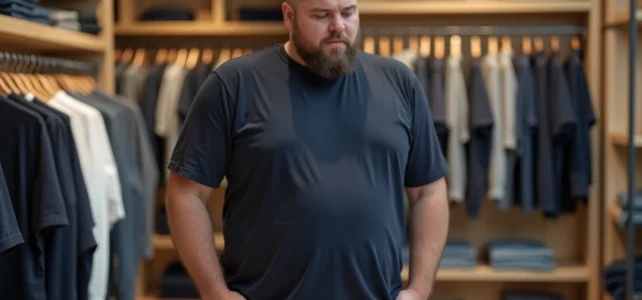
Size 7XL now appears on many online product listings, from parkas to jackets and shirts. However, this label does not refer to a single measurement: a 7XL from one manufacturer may correspond to a 4XL or 5XL from another. Understanding what this size truly encompasses requires thinking in centimeters, not letters.
7XL Correspondence: Major Discrepancies Between Brands and Types of Clothing
The central issue with size 7XL lies in the absence of an international standard. Traditional size guides generally stop at XXXL (French size 64), which corresponds to a chest measurement of around 125-128 cm according to the Amazon reference. Beyond that, each brand defines its own thresholds.
You may also like : Ideas and tips to succeed in your renovation and interior decoration projects
At Babista, for example, jackets go up to 7XL, but this 7XL corresponds to a chest measurement that other European brands would cover with a 4XL or 5XL. Multi-brand shops that display “up to 7XL” without harmonizing measurements between suppliers amplify the confusion.
| International Size | Indicative French Size | Chest Measurement (cm) – Standard Reference |
|---|---|---|
| XL | 54-58 | 104-116 |
| XXL | 60-62 | 116-124 |
| XXXL | 64 | 125-128 |
| 4XL and beyond | 66+ | Variable by brand |
| 7XL | No fixed equivalence | Varies from 140 to 170+ depending on the manufacturer |
This table illustrates a fundamental point: beyond XXXL, standardized correspondences no longer exist. The only reliable data remains the size chart specific to each product.
Read also : The best sites to quickly and easily find a job in France
To learn everything about size 7XL, one must reason based on their own body measurements and compare them to each size guide, brand by brand.

Taking Measurements for a 7XL Garment: Critical Areas
The usual measurements (chest circumference, waist circumference, sleeve length) remain the foundation. However, for such large sizes, certain areas take on particular importance that generic guides often overlook.
Chest and Waist Circumference
The chest circumference is measured at the fullest part of the bust, with arms at the sides. For plus-size clothing, the waist measurement is as important as the chest measurement. In a body shape where the waist is wider than the chest, it is this measurement that determines the actual fit of the garment, not the chest measurement alone.
Back Length and Armholes
Brands that offer 7XL often add width without proportionally adjusting the length. A 7XL jacket may be wide enough for the bust but too short in the back. Checking the total length of the garment (from collar to hem) and the depth of the armhole on the product listing can prevent returns.
- Chest circumference: measure with a flexible measuring tape, horizontally, without tightening, while breathing normally
- Waist circumference: measure at the widest point of the abdomen, standing and relaxed
- Sleeve length: from the top of the shoulder to the wrist, with the arm slightly bent
- Total length: from the base of the neck to the desired height (mid-thigh for a jacket, hips for a coat)
Loose Fit and Layering: The Specific Logic of 7XL
7XL is not simply a proportional enlargement of a standard model. On jackets, parkas, and down jackets, product listings frequently mention a “loose” or “relaxed fit.” This terminology reflects a design choice: 7XL incorporates a margin for layering (thick sweater, fleece, technical under-jacket).
This means that ordering a 7XL to wear a simple t-shirt underneath may result in a loose fit. Conversely, opting for the size just below, thinking it will be fitted, risks compressing at the shoulders as soon as an intermediate layer is added.
The 7XL offering has significantly expanded online, driven by specific segments. Men’s fashion websites now offer technical and leisure jackets up to 7XL as standard, where they previously stopped at 4XL or 5XL. Platforms like AliExpress highlight leather jackets and coats in 6XL, 7XL, and 8XL as a selling point, indicating that the demand for these extreme sizes goes beyond mere functionality to include style criteria.
Check the Manufacturer’s Size Chart: A Concrete Method Before Each Purchase
Each purchase in 7XL should follow a three-step verification. Take your measurements (see previous section), open the size guide specific to the product, and then compare centimeter by centimeter.
Some sites display the flat dimensions of the garment (chest width, total length). Others indicate the recommended body measurements. Confusing garment measurement with body measurement skews the entire process. A jacket that shows 70 cm of chest width flat corresponds to a circumference of 140 cm, not a body chest measurement of 70 cm.
Customer reviews mentioning their size and weight provide useful insights, as long as you compare similar body types. A positive review from a buyer measuring 190 cm and weighing 130 kg does not hold the same value for a buyer who is 170 cm with an equivalent waist measurement.
Size 7XL remains a commercial indication, not a standardized measurement. As long as manufacturers do not adopt a common reference beyond XXXL, the measuring tape remains the only reliable tool. Taking five minutes to measure three areas of the body before each order reduces returns and disappointments far more effectively than any generic size chart.