
The yellow heart on Snapchat indicates a mutual number-one best friend ranking. Both accounts send each other more Snaps than they send to any other contact. It’s neither a badge of affection nor an indicator of real-life closeness, but an interaction metric calculated by the app.
Snapchat’s best friend ranking algorithm: what the platform doesn’t document
Snapchat has never made public the exact formula used to award the yellow heart. Available guides agree on one point: the calculation is based on the volume of mutual interactions (photo and video Snaps sent and received). Text messages in chat seem to carry less weight, or may not factor into the friend ranking at all.
If the relative volume of interactions changes (for example, you start Snapping someone else more often), the yellow heart disappears without notice. The emoji isn’t permanent; it’s a dynamic indicator that’s continuously recalculated.
We find that many users confuse the yellow heart with the flame (Snapstreak). The flame indicates a consecutive streak of days on which two accounts have each sent the other at least one Snap. The yellow heart, by contrast, doesn’t depend on daily consistency, but on your relative ranking among all your contacts. Two distinct metrics, two different systems.
To learn more about what the yellow heart on Snapchat means, you have to accept this algorithmic opacity and look at trends rather than fixed thresholds.

Yellow, red, pink hearts: how Snapchat friendship emojis progress
The yellow heart is just the first step on Snapchat’s relationship loyalty scale. If two accounts maintain their mutual best friend status for long enough, the emoji changes automatically.
- Yellow heart: you’re each other’s number-one contact. This is the starting point for a mutual ranking.
- Red heart: you’ve maintained mutual best friend status over time. No extra action is required; the change happens based on duration alone.
- Pink hearts (two pink hearts): the highest level in the friendship emoji system, reached after an even longer period of mutual ranking.
Each transition happens automatically and remains in place as long as the ranking stays stable. However, if another contact takes the top spot, the emoji changes or disappears. There’s no way to lock in a heart once you’ve earned it.
How non-reciprocal friendship emojis differ
Snapchat also assigns one-sided emojis. A smiling face appears when someone is one of your best friends, but the relationship isn’t mutual. A grimacing face indicates that your number-one best friend is also someone else’s number-one best friend. These emojis don’t follow the same progression as the yellow-red-pink heart sequence.
Customizing Snapchat emojis: a technical detail that’s often overlooked
Snapchat lets you change the appearance of friend emojis in the app settings. Users can replace the yellow heart with any emoji they choose. This customization is strictly local and one-sided: it only changes how the emoji appears on the account where the setting was changed.
So two friends who share mutual best friend status may see completely different symbols next to each other’s names. One might see the default yellow heart, while the other sees a star or a sun. The underlying ranking stays the same; only the visual layer changes.
This is a common source of misunderstandings. If a contact says they can’t see a yellow heart even though you can, emoji customization is the most likely explanation before assuming the ranking has changed.
Losing the yellow heart on Snapchat: technical and behavioral causes
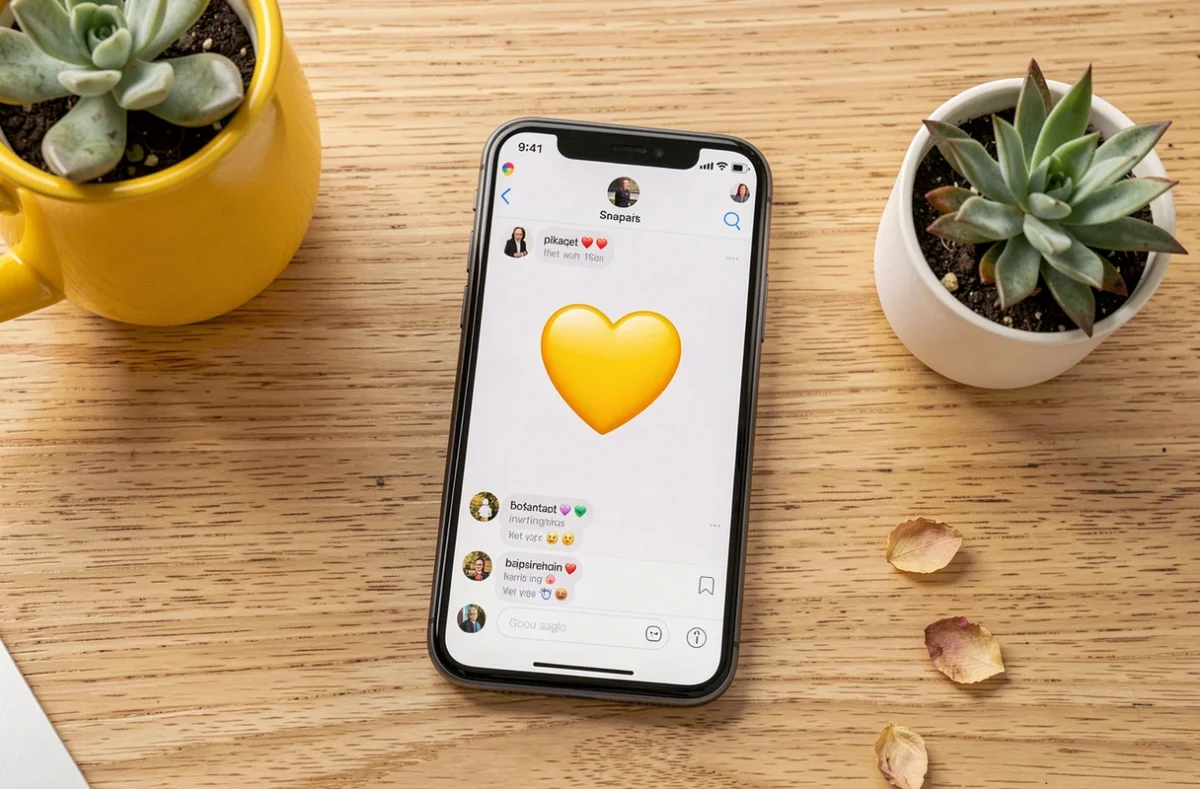
The yellow heart disappears when your relative ranking changes. Three main scenarios can explain why.
- You’ve increased your interactions with another contact, who moves ahead in the ranking. The yellow heart shifts to this new relationship if it becomes mutual.
- Your friend has started Snapping someone else more often. The mutual number-one ranking is broken, and the emoji disappears on your end.
- A prolonged period of inactivity (a vacation or a break from the app) mechanically reduces your interaction volume. More active contacts move into the top spot.
Snapchat doesn’t notify you when a friendship emoji disappears. The only way to notice is to check your friends list and see that the symbol is gone. The app doesn’t provide access to a history of past emojis.
Getting back a lost yellow heart
The only way is to resume exchanging enough Snaps to become each other’s number-one contact again. Text messages alone probably won’t be enough. Photo and video Snaps remain the type of interaction that counts toward the ranking.
Snapchat’s friendship emoji system is deliberately opaque about its exact thresholds. The yellow heart reflects a statistical pattern of interactions, not a relationship declaration. Keeping this distinction in mind helps avoid overinterpreting things and getting frustrated when the emoji changes or disappears.