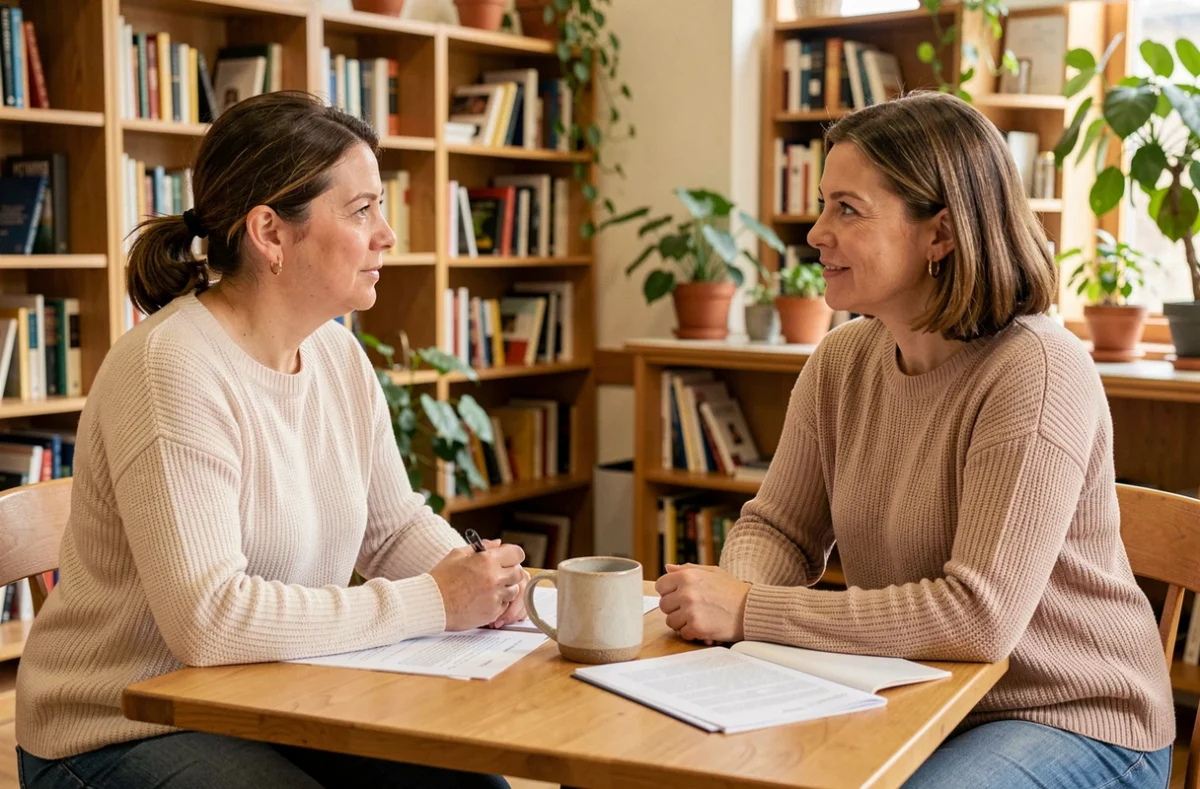
A women’s center is an associative structure that offers free and confidential support to women facing personal, social, or violence-related difficulties. The term encompasses a range of coordinated services: individual listening, referral to professionals, support groups, and collective activities aimed at fostering autonomy.
Multidisciplinary approach in a women’s center: beyond a one-stop shop
The most structured women’s centers do not limit themselves to a helpline or occasional support. Their uniqueness lies in the coordination of several disciplines under one roof: psychosocial support, legal assistance, health guidance, social follow-up, and sometimes care for child co-victims.
This model has developed in recent years in France, inspired by structures like the Maison des femmes de Saint-Denis, which brings together units dedicated to violence, family planning, and female genital mutilation, with a multidisciplinary team. The goal is to allow a woman to access multiple forms of help without having to repeat her story to each interlocutor.
Associative structures carry this same logic at the local level. On the Centre de Femmes Entrelles website, there is a concrete example of this comprehensive approach, centered around listening, support, and mutual aid among women.

Listening and psychosocial support: what the service really entails
The word “listening” is often used vaguely. In a committed women’s center, it refers to a specific professional framework. The trained practitioners generally use feminist intervention, a method that emphasizes women’s empowerment over their own lives.
This approach is not limited to spontaneous empathy. It aims for identifiable objectives:
- The development of the ability to assert oneself and defend one’s rights in the face of institutions or one’s surroundings
- The enhancement of self-esteem, weakened by situations of violence or prolonged isolation
- The awareness of multiple oppressions (economic, marital, administrative) that overlap in the journey of the same person
Consultations are most often free, anonymous, and accessible in person or remotely. The service is aimed at all women, not just victims of domestic violence.
Confidentiality and accessibility of the system
A point rarely detailed by other structures: confidentiality is a structural framework, not a moral promise. Practitioners are bound by ethical rules comparable to those of psychologists. Exchanges are not recorded in a shared file without explicit consent.
Accessibility also includes adapted time slots (evening consultations, by phone) for women who cannot move freely, particularly in situations of marital control.
Collective mutual aid and group activities: an underestimated lever
Individual support is not always sufficient. Women’s centers also offer collective activities, in open groups (free participation, no registration) or closed groups (several weeks, prior registration).
These groups are not informal talking circles. They are led by professionals and follow a thematic progression: stress management, parenting, professional integration, legal knowledge. The group acts as a space for normalizing experiences, where participants realize that their difficulties are not a personal failure.
Mutual aid among participants also produces concrete effects: sharing information on administrative procedures, recommendations for health professionals, occasional logistical support. This informal network extends the center’s action beyond opening hours.
Funding for feminist associations: a fragility that directly affects services
The quality of support directly depends on the available resources. The 2026 Barometer of feminist associations, published by the Fondation des Femmes, indicates that two-thirds of the associations surveyed report an increase in their activity related to the recent social and political context.
At the same time, the 2025 activity report of the Fondation des Femmes notes a significant financial deterioration for some of these structures, with direct consequences on the number of people actually supported. Some associations must reduce their reception, orientation, or collective support.
What this changes for women seeking a center
This tension between rising demand and decreasing resources translates into longer waiting times for individual consultations, a reduction in the number of groups offered, and sometimes the elimination of legal support services.
Centers that maintain a full offering often do so thanks to a network of trained volunteers and local partnerships with CIDFF (Centres d’information sur les droits des femmes et des familles), mental health services, or specialized housing programs.
- CIDFFs provide free legal support in many cities
- National helplines like 3919 (Violences Femmes Info) remain accessible for free, anonymously, and continuously
- Justice and law houses offer complementary access to family law and mediation
Seeking a women’s center remains one of the first concrete steps possible to break out of isolation, regardless of the difficulties faced. The free and confidential nature of the services removes the two most common barriers. Even in a context of constrained resources, these structures continue to play a role that neither public services nor private professionals can fulfill alone.