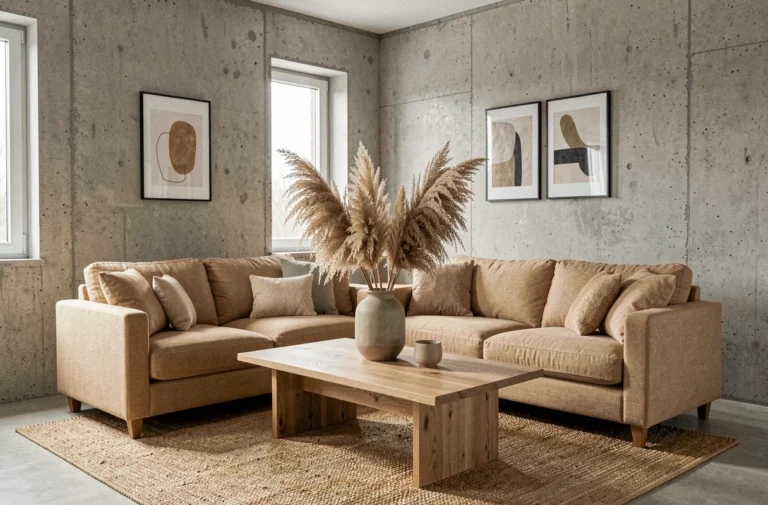
A load-bearing wall that cannot be touched, a concrete column in the middle of the living room, a budget that shrinks faster than expected for plumbing work: interior renovation rarely goes as imagined on a Pinterest mood board. Successfully completing renovation and interior decoration projects requires starting from the real constraints of the building, not from a color palette.
Building Constraints: What Your Walls Impose Before Any Decoration
Before choosing a covering or shade, we start by reading the walls. In an old apartment, plaster brick partitions do not support the same loads as drywall on a metal frame. An uneven floor with several centimeters of difference between two rooms determines the type of possible covering and the leveling budget.
On a renovation site, the technical diagnosis always precedes the aesthetic choice. We identify existing electrical conduits, the condition of the panel, and any potential moisture at the base of the wall. These elements guide the next steps: there’s no point in applying high-end wallpaper on a wall that hasn’t been treated against rising damp.
To consult the work on the Deco Asaiss website, you will find concrete ideas that intersect renovation and decoration within this practical logic.

Energy Renovation and Interior Decoration: Combining Projects
The latest developments in MaPrimeRénov’ and Energy Savings Certificates encourage bundles of work rather than isolated interventions. When redesigning the interior layout of a room, it’s the right time to integrate internal insulation or replace an aging convector with an inertia radiator.
Combining insulation and wall refurbishment reduces the overall cost compared to two separate interventions. You avoid paying twice for the removal and reinstallation of baseboards, the relocation of outlets, and the finishing of corners. The drywall installer intervenes only once, and the decoration comes as the final layer on a clean and efficient surface.
Ventilation and Material Choices
A often overlooked point: improving air tightness without addressing ventilation creates condensation problems. If we insulate and apply a decorative lime plaster at the same time, we need to ensure that air renewal is sufficient. Feedback on this point varies depending on the housing configuration, but a properly sized single-flow VMC remains the minimum.
Small Budget Decor Projects: Painting and Partial Makeovers
Not everyone has the budget for a complete renovation. The trend towards small decor projects is growing, driven by rising labor costs. A well-used pot of paint can transform a space without touching the structural work.
We’re not just talking about repainting an entire wall. The most effective interventions target specific areas:
- An accent wall behind a sofa or headboard, which visually structures the room without repainting the whole
- The edges of doors and frames in a contrasting color, a detail that changes the perception of volumes
- The back of a bookshelf or niche, to create depth with a bold shade
- The kitchen backsplash repainted with paint suitable for humid areas, replacing dated tiles
These micro-interventions cost a fraction of a traditional renovation and allow for deferring heavier structural work. Transformations can be staggered room by room, starting with the living room or bathroom, which are the spaces where visual impact is most immediate.

Lighting and Volumes: Two Often Underutilized Levers in Renovation
Lighting is the poor relative of most interior decoration projects. We invest in beautiful flooring, custom furniture, and then screw in a central ceiling light that overshadows all the work. A lighting plan should be thought out in three layers: general light (ceiling light or recessed spots), functional light (workspace in the kitchen, reading light in the bedroom), ambient light (sconces, indirect LED strips).
In renovation, running cables to add light points is simpler than one might think when the walls are already open for other work. We return to the logic of coupling: take advantage of the insulation or partition refurbishment project to pull conduits to new locations.
Playing with Ceiling Height
In a space with low ceilings, color and light do more than any layout. Painting the ceiling a lighter shade than the walls and placing light sources at low peripheral points (floor lamps, mid-height sconces) creates a sense of volume. Conversely, a large space that is too high gains intimacy with a ceiling painted in a darker shade than the walls.
The choice of flooring materials also influences perception: a floor laid lengthwise visually elongates a short room, while large-format tiles with thin joints enlarge a narrow bathroom.
Order of Interventions on an Interior Project
On a renovation site that combines technical work and decorative finishes, the order of intervention avoids costly rework. Here’s the sequence that minimizes damage:
- Demolition and structural work (removal of partitions, openings, structural repairs)
- Technical networks: electricity, plumbing, ventilation, running conduits
- Insulation and partitioning, installation of interior joinery
- Floor coverings (except wall painting, which sometimes precedes the floor depending on the type of finish)
- Wall finishes: plaster, paint, wallpaper, tiles
- Installation of sanitary equipment, lighting fixtures, hardware
Reversing two steps, for example, laying the flooring before painting the ceiling, exposes you to splashes, scratches, and touch-ups. Each poorly sequenced lot generates lost time and additional costs.
The success of an interior renovation relies less on selecting a decor trend than on the rigor of sequencing and the ability to combine interventions. A well-insulated, properly lit wall painted in the right shade does not necessarily cost more than a wall simply repainted twice in three years because the surface was not prepared.