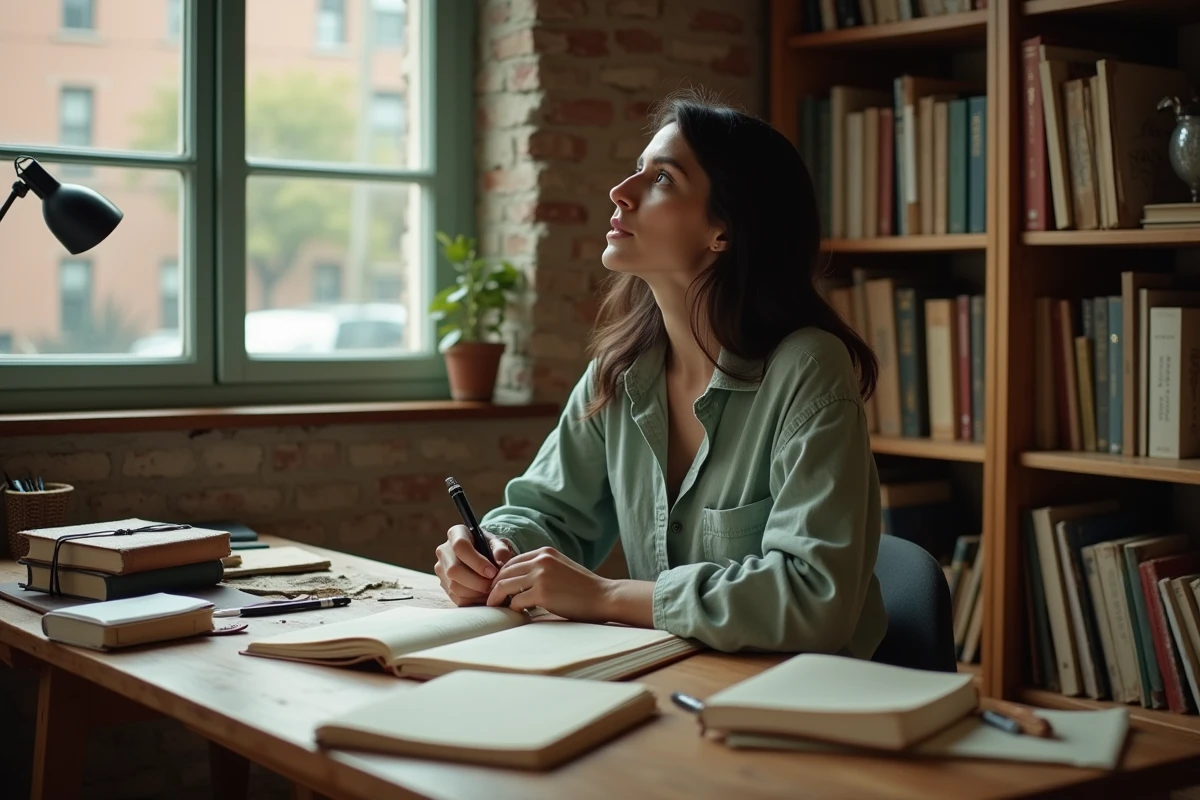
Moon is a pseudonym. Behind this short name is a French-speaking author who publishes creative texts blending personal narrative and illustration. Her journey is interesting because it raises a concrete question: how to carve out a place in online publishing when choosing not to reveal one’s civil identity?
Pseudonym and Amazon algorithms: Moon’s challenge to exist online
Have you ever typed an author’s name on Amazon and noticed that the top results highlight well-detailed profiles, complete with photos, detailed biographies, and links to social media? Recommendation algorithms favor complete profiles.
For a pseudonymous author like Moon, this logic creates a direct obstacle. The less personal information the author profile contains, the lower it ranks in suggestions. Online sales platforms classify profiles based on a trust score that incorporates the consistency between the name, biography, and metadata of the works.
Publishing under a pseudonym mechanically reduces algorithmic visibility. Moon circumvents this barrier by working on two levers: a recognizable visual universe on her covers and a regular presence as an author on Le Blog de Coco, where her texts build an editorial identity independent of her civil status.
The European directive on digital copyright, which came into effect in 2025, adds a layer of complexity. It imposes increased transparency for pseudonyms in Amazon biographies, with an optional but verifiable identity declaration. For emerging authors, this means a delicate balancing act between privacy protection and regulatory compliance.

Hybrid creation between personal narrative and visual art
Moon’s work does not easily fit into a category. Her publications combine narrative text and graphic elements, a format increasingly found in self-published independent publishing houses.
The hybrid format blending narrative and illustration has been gaining ground since 2024. Digital platforms facilitate this type of creation by removing traditional printing constraints. An author can integrate full-page visuals without negotiating with a publisher over the cost of glossy paper.
Moon is part of this movement with a personal approach. Her texts often stem from a lived experience, transformed into a short narrative, accompanied by illustrations that do not merely decorate the text but extend its meaning. The result resembles more of a published diary than a classic book.
What this format changes for the reader
An illustrated narrative is read differently than a novel. The pace slows down. The image imposes a pause, a moment of observation. For Moon, this choice is not decorative: it structures the narrative itself.
This positioning attracts a readership looking for atypical editorial objects, halfway between an art book and a creative journal. Feedback on this type of publication shows a strong attachment from readers to the physical object, even when the discovery happens online.
Instagram Reels and promoting creative works without public identity
Why Instagram rather than another network? Because the visual format perfectly matches the type of content Moon produces. Reels, in particular, offer a formidable promotional lever for creative books.
According to a study published by Livres Hebdo in April 2026, immersive Reels generate a significantly higher conversion than static posts for self-publishing French-speaking authors. The short video allows for flipping through a book, showcasing the textures of the paper, and reading an excerpt aloud.
For a pseudonymous author, Reels present an additional advantage: one can show the book without showing their face. Moon uses this format by focusing on the pages, illustrations, and hands turning the leaves. The author’s identity remains protected while the work gains visibility.
- Focus on the object: showing double pages, illustration details, the spine of the book, without ever revealing the author
- Voice-over reading: an excerpt read over musical background creates an immersive atmosphere and bypasses the absence of face-camera
- Interactive Stories: polls, open questions to followers about the next theme, generating algorithmic engagement without personal exposure

Building a coherent editorial line under a pseudonym
The pseudonym poses a problem that many underestimate: brand coherence. Without a real surname, the author must create a recognizable universe from scratch.
Moon achieves this through three consistent choices. First, an identifiable graphic palette on each cover. Next, recurring themes (inner life, creativity, the passage of seasons). Finally, a stable writing tone, neither too literary nor too familiar.
- Recurring visual palette on covers and promotional visuals
- Themes related to creative life and introspection
- Accessible tone, grounded in concrete experience rather than artistic theory
- Regular publication on an identified blog, serving as a reference point for the loyal readership
The regularity of publication matters as much as the quality of a single work. The algorithms of sales platforms and social networks reward frequency. For a pseudonymous author, regularly publishing articles or excerpts compensates for the lack of nominative notoriety.
The blog as an editorial anchor
An Amazon profile alone is not enough to retain a readership. The blog offers a space where Moon develops her voice outside commercial constraints. The published texts are not product sheets: they are extensions of her creative universe.
The blog remains the only editorial space that an author fully controls. Social networks change their rules, sales platforms modify their algorithms. A personal blog, however, belongs to the author.
Moon’s journey illustrates a reality of online publishing: creativity alone is not enough. One must also understand how distribution tools work, adapt their visibility strategy to a pseudonym, and publish consistently across multiple channels. It is a complete editorial job, distinct from writing itself.